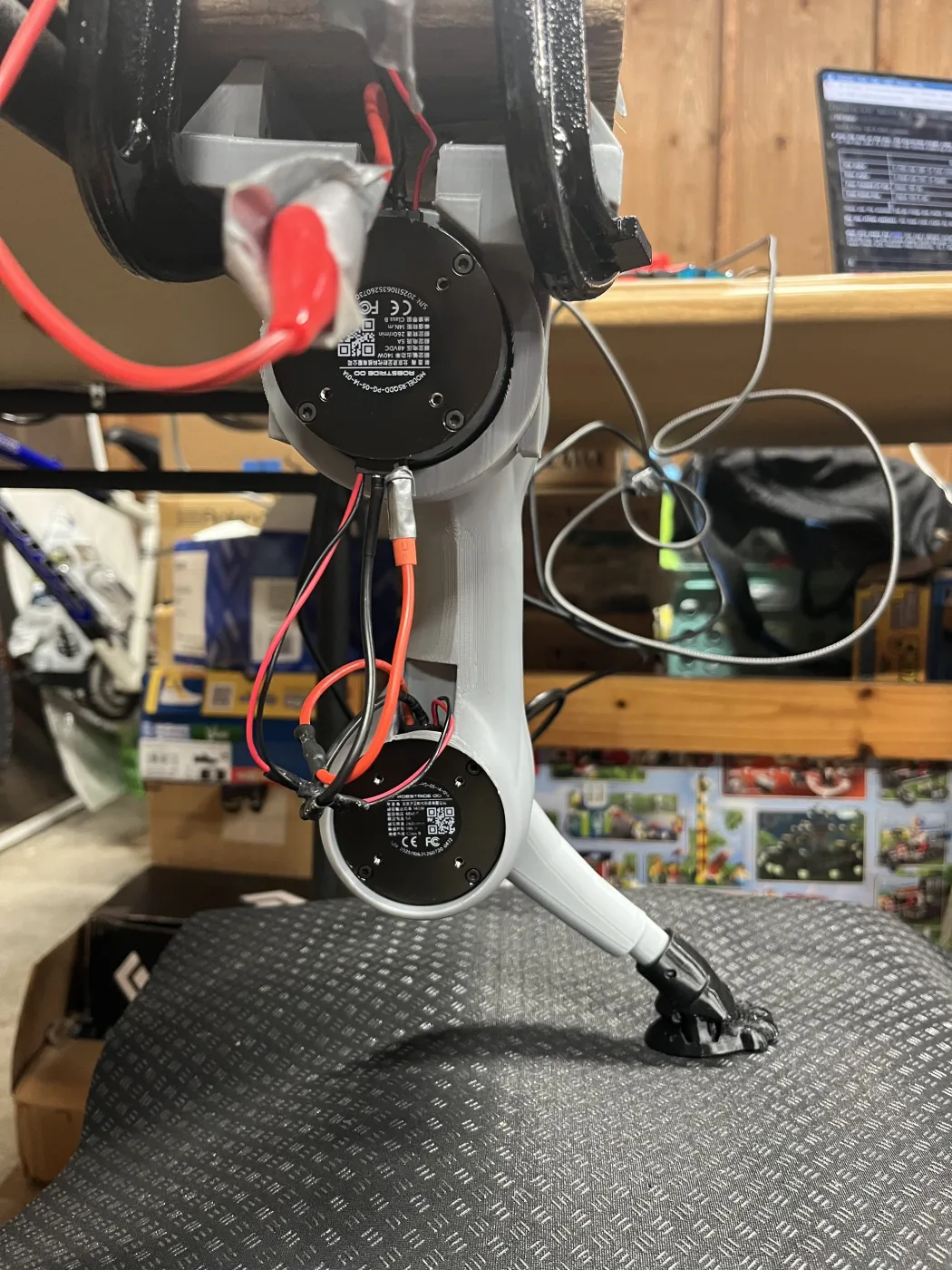
Today the new 2.0b leg went onto the beam rig. I wanted to know three things. Does it drive correctly, does it heat up differently from the old leg, and can it hop?
First power-up
Both motors answered right away with no faults. The new mount changed the hip's zero by about 2.1 rad, so the old limits were useless. With the motors off, I held the thigh plumb and moved each joint by hand while the angles were recorded. The first powered run kept the foot in the air, and tracking stayed within 0.007 rad.
Heat runs
Next I repeated the 1.5 Hz bounce from my last test of the old leg, the 1.0f version. The table skips the first two minutes of each 10-minute run, except for the long run, which skips the first 20 seconds of each run.
| Run | Average load | Average knee torque | Knee motor temperature |
|---|---|---|---|
| Old leg, 10 minutes | 21.7 N | 1.49 N·m | 20 to 30 °C |
| 2.0b leg, 10 minutes | 17.3 N | 1.19 N·m | 24 to 30 °C |
| 2.0b leg, 30 minutes | About 18 N | About 1.25 N·m | 38 to 48 °C |
The 2.0b leg's knee rose more slowly, but it was also carrying less. Motor heating grows with the square of the torque, and that alone predicts almost the whole difference. So I can't say the new leg runs cooler. It does look about the same, which is still good news.
After 30 minutes the knee was at 48 °C and still rising, at about 0.2 K/min. I still haven't found where it levels off. This load is also under half of what a leg should carry in a trot, so the knee heat question stays open. After an earlier run, with the knee motor at 40 °C, the thigh beside it felt only a tiny bit warm.
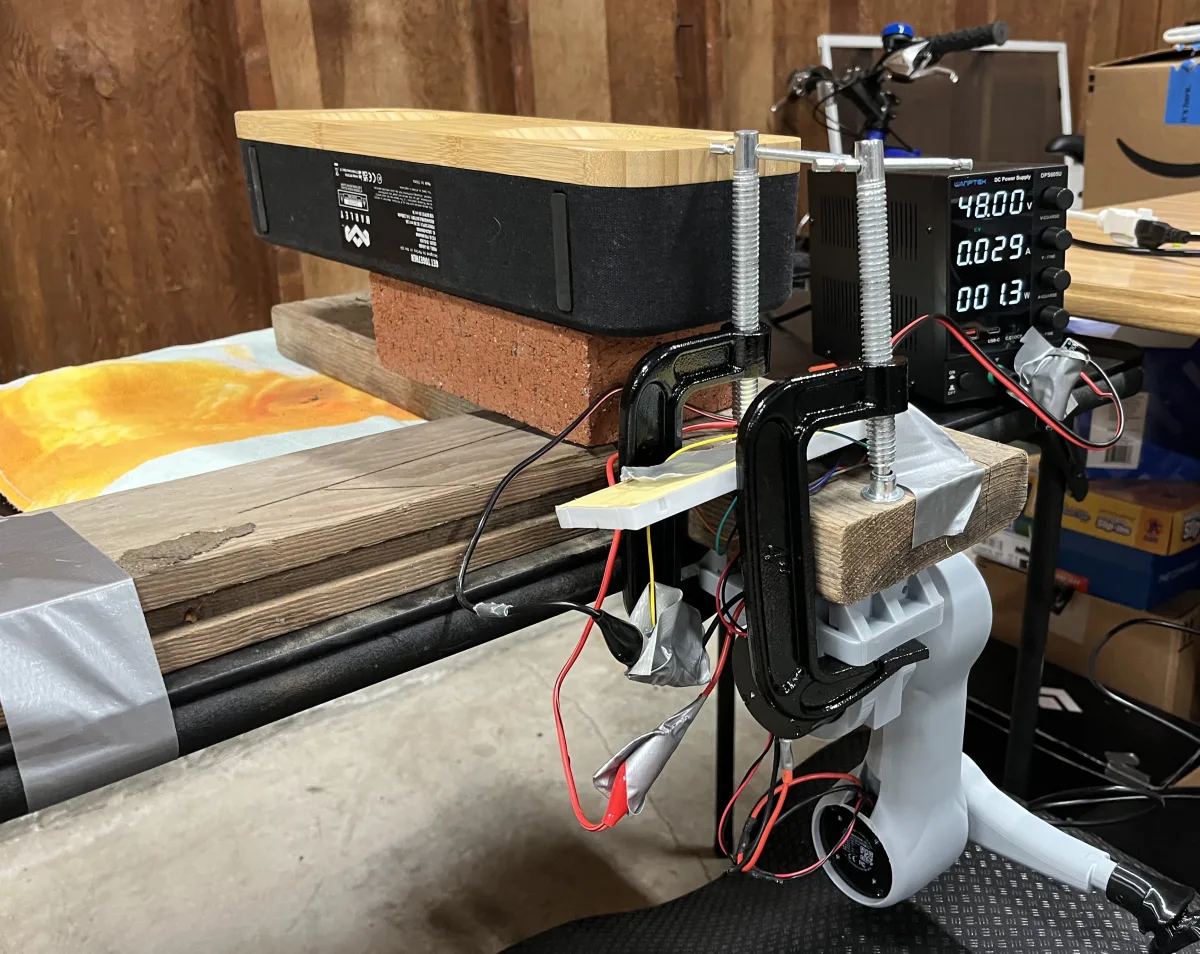
Two small things changed the numbers a lot. The brick and speaker in the photo doubled the knee torque during a slow squat. Then, during one long run, a book under the mat slipped and the load sagged to about 13 N until I put it back. For a test like this, the foot needs something solid to stand on.
Hopping
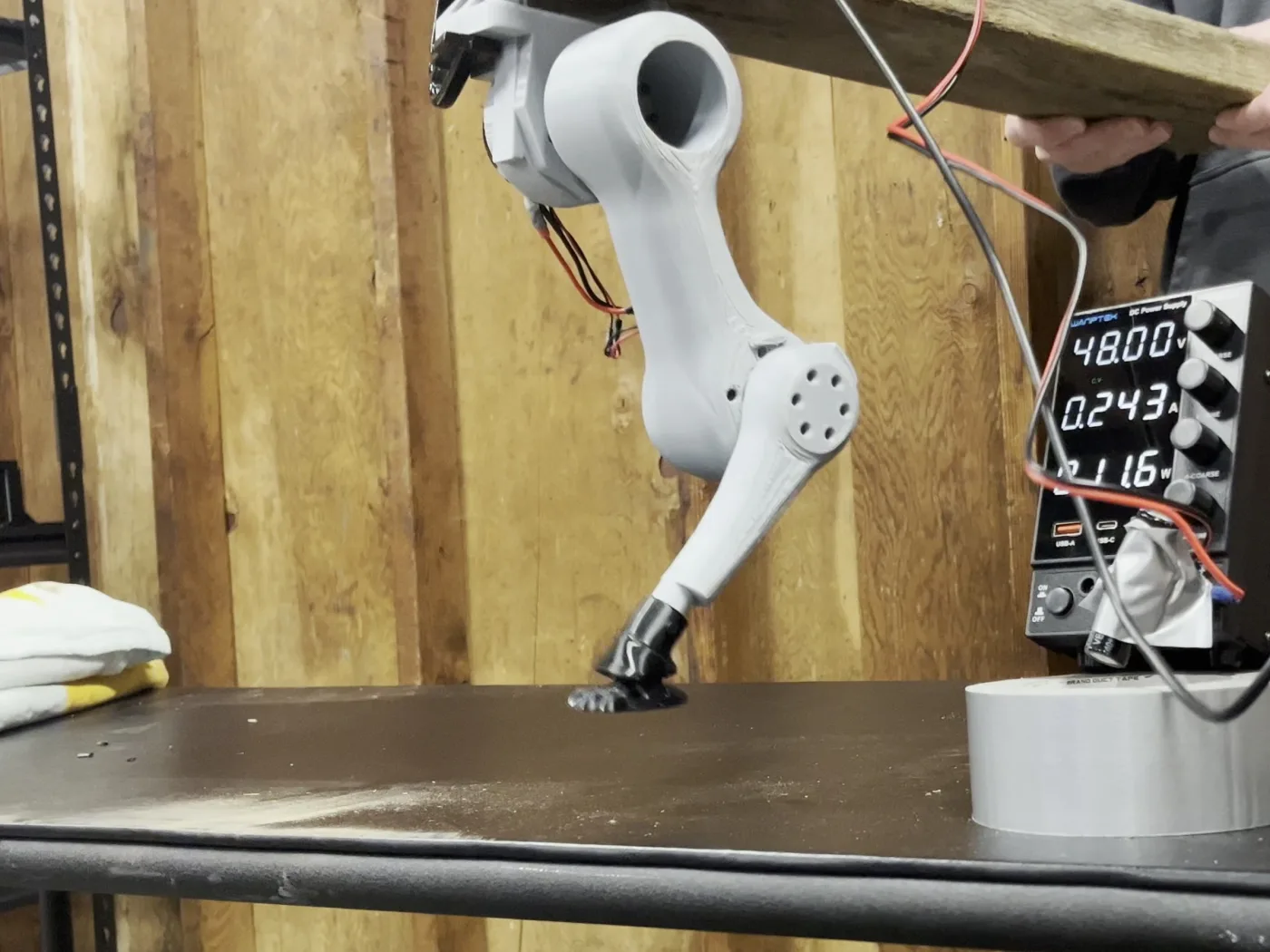
For the hops I held the beam in my hands, as I did with the old leg. The first run taught me something right away. Every run ends with the foot rising and both motors switching off. With nothing else holding the beam, it nearly crashed down, and I had to catch it. Now the computer says "take the weight" out loud a few seconds before that happens.
| Push asked for | What happened | Peak knee torque |
|---|---|---|
| 0.5 m/s, one hop | Finished normally | 3.4 N·m |
| 0.7 m/s, one hop | Finished normally | 4.3 N·m |
| 0.7 m/s, 10 hops | All 10 landed, 0.12 to 0.2 s in the air | 5.6 N·m |
| 0.8 m/s, 10 hops | All 10 landed, 0.13 to 0.19 s in the air | 5.5 N·m |
| 1.0 m/s, 10 hops | Both motors faulted on the first hop | 6.3 N·m before the fault |
Up to 0.8 m/s the 2.0b leg hopped about as well as the old one, and nothing cracked or came loose. The motors stayed near 42 °C through the sets, even though they started warm.
The 1.0 m/s fault
At 1.0 m/s, both motors reported overcurrent at the same moment, right at the end of the push. They shut off, and the leg went limp. Afterward both answered normally, with no faults left.
My best guess is the bench supply. I think its current limit, the most current it will deliver before it holds back, was set to 1 A. At 48 V that allows only 48 W for both motors. Just before the fault, the knee alone was putting out about 70 W of mechanical power. I'm not sure yet, because the motors reported overcurrent instead of low voltage, and I wasn't logging the voltage during the hop.
Next steps
- Raise the supply's current limit to 4 A, check the motor wires, then try the same 1.0 m/s push as a single hop.
- Run a heat test near the torque the simulation predicts for walking at 1 m/s, about 2.6 to 3.0 N·m, starting from cold.
- Give the foot a solid surface so the load stays steady.