Two days ago, the 1.0 m/s hop in Log 11 ended with both motors faulting on the first push. My best guess was the power supply, which I remembered being limited to about 1 A. Tonight I raised the limit to 4 A and went back to find out. The leg ended up doing 10 hops in a row at 1.1 m/s, faster than I had planned to go.
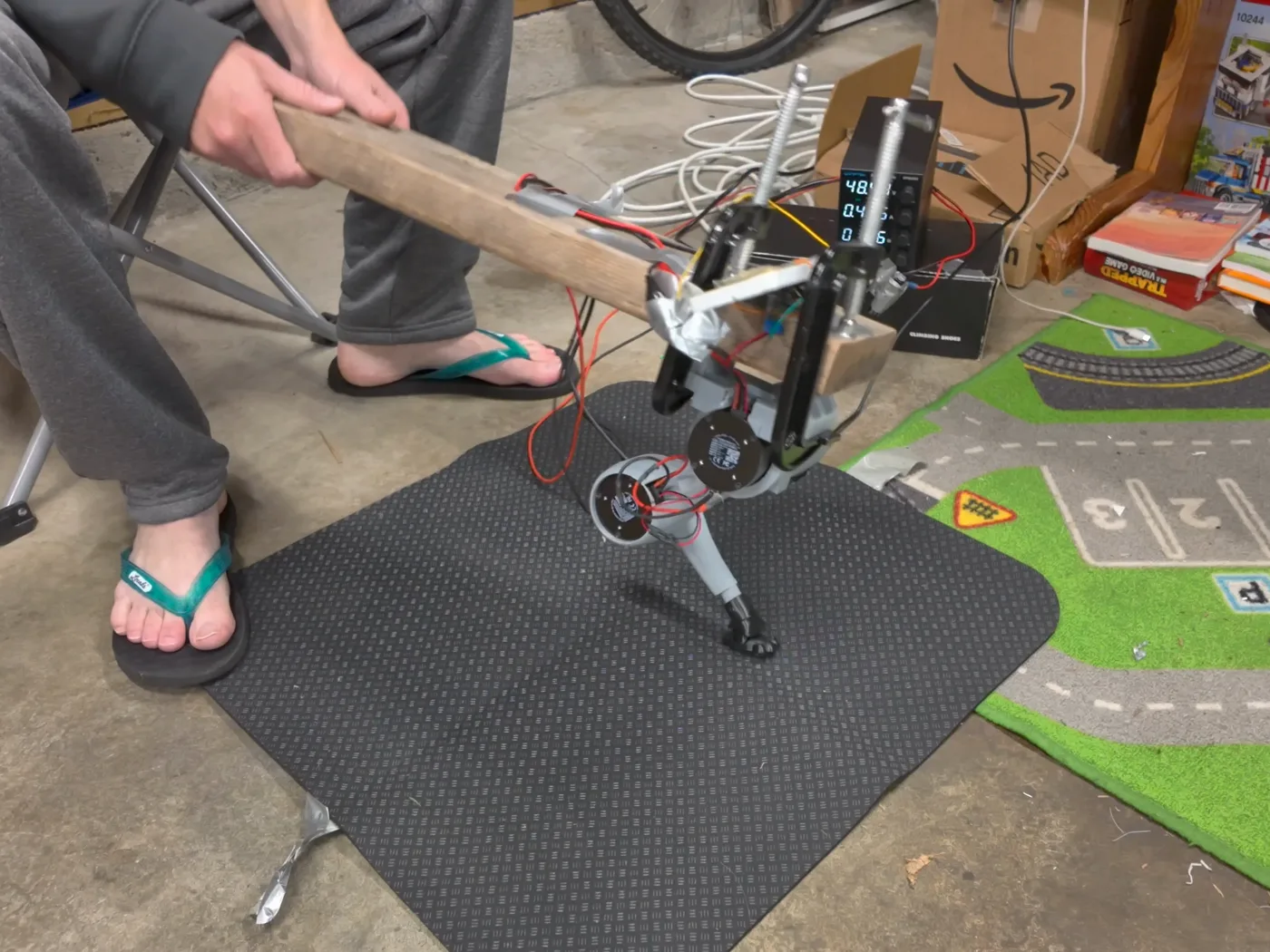
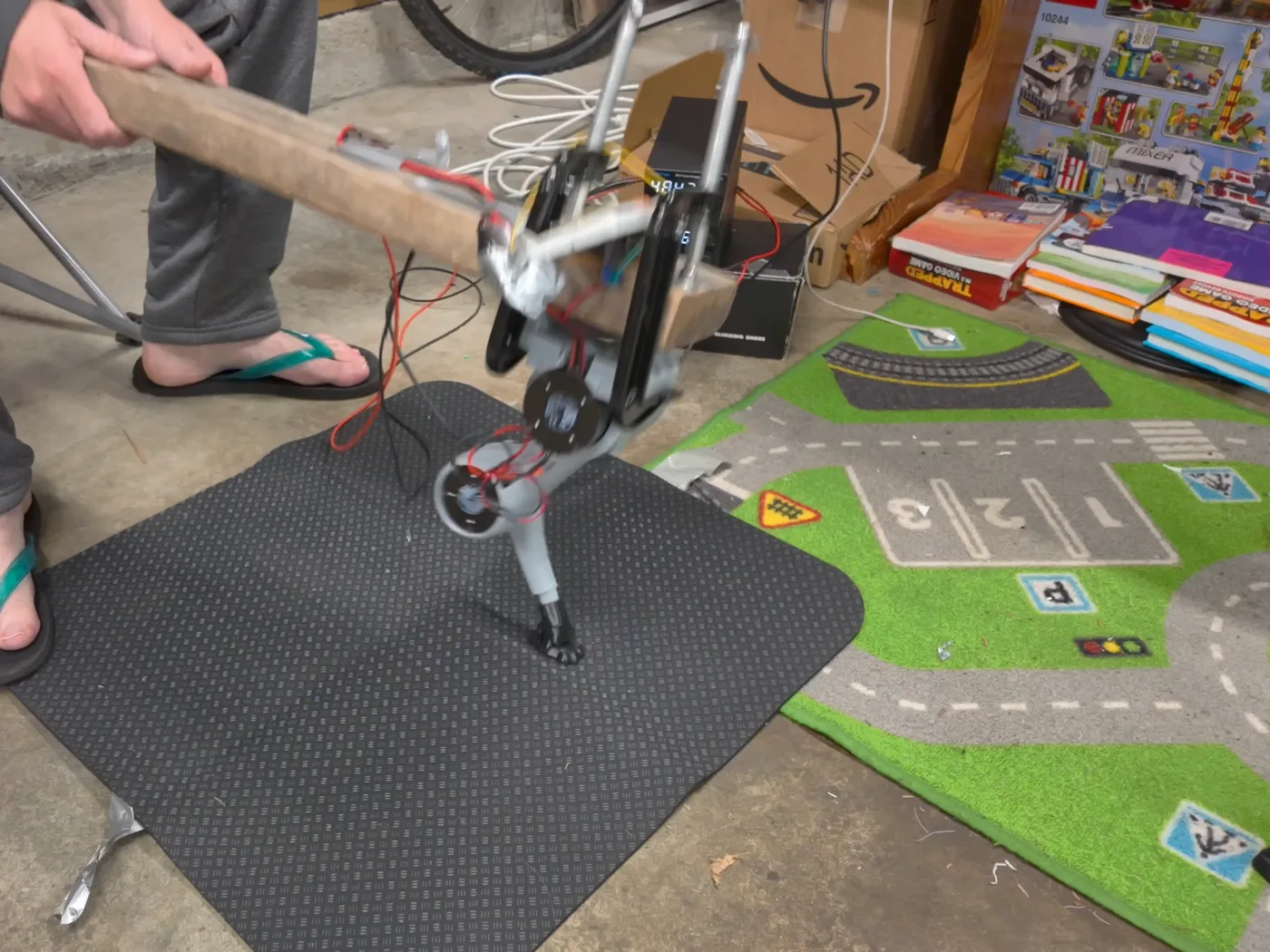
A swap after the rebuild
I had just rewired and rebuilt the leg, so I checked it by hand before any powered move. With the motors off, I moved each joint to its ends while the angles were read back. Folding the knee moved the motor called the hip, and moving the hip moved the motor called the knee. The two motors had traded places during the rebuild without my noticing.
Sending hip commands to the knee would have been a bad way to find out. Swapping the two saved CAN IDs fixed it with no disassembly. The joint ranges and zero positions were measured again, since the old numbers came from the other motor in each joint. A slow move in the air then landed within 0.004 rad of where the math predicted.
Trying to go hands-free
Holding the rig means my hands share the load, so I tried letting the beam rest on a box instead, with weight on its far end. The hip height took several tries to get right, and reading the angles with the paw on the mat worked much better than a tape measure. Hops at 0.5 m/s ran without a fault, but the beam rolled and crept sideways. The thigh also seemed to press against the box in some runs, which showed up clearly as hip torque while the foot was in the air. Weights and moving the rig didn't cure it. The beam needs a real pivot, so I went back to holding it for now.
Stepping up the speed
I held each step for 10 hops in a row and checked the numbers before the next one. The 0.5 m/s run used separate hops with a pause between them. The rest were continuous, with each landing running straight into the next push, about two to three hops per second.
| Push | Hops | Time in the air | Knee peak | Hip peak | Hottest motor |
|---|---|---|---|---|---|
| 0.5 m/s, separate | 10 of 10 | Not measured | 3.6 N·m | 3.8 N·m | 32 °C |
| 0.7 m/s | 10 of 10 | 110–158 ms | 6.9 N·m | 2.5 N·m | 33 °C |
| 0.8 m/s | 10 of 10 | 130–154 ms | 6.7 N·m | 3.1 N·m | 34 °C |
| 0.9 m/s | 10 of 10, twice | 158–199 ms | 6.8 N·m | 4.1 N·m | 36 °C |
| 1.0 m/s | 10 of 10 | 169–195 ms | 7.2 N·m | 3.7 N·m | 37 °C |
| 1.1 m/s | 10 of 10 | 188–215 ms | 7.4 N·m | 5.0 N·m | 33 °C |
The 1.0 m/s run is the one that faulted on November 4. This time, it ran with no faults. That supports the supply limit as the cause, but it isn't proof, because the leg had also been rebuilt.
Getting past 1.0 m/s
The firmware refused anything above 1.0 m/s, so I raised that cap. Then it refused the 1.1 m/s plan too, because the top of the hop would have brought the knee too close to straight. Starting the whole push 5 mm lower fixed that, with the same 27 mm of travel.
The first try at 1.1 m/s stopped itself after two hops. The second hop stayed in the air longer, about 270 ms, and absorbing that landing would have taken the foot below the firmware's lowest allowed height. So it caught the leg and ended the series, as designed. I can't tell whether the leg really flew that long or my hands lifted it. On the next try, I held the rig steadier, and it did all 10.
What the motors showed
The knee holds about 7 N·m through most of a push, and its speed peaks at about 13 rad/s just as the torque starts to fall. Compared with 1.0 m/s, flights ran about 10% longer. Using the time in the air, that's about 5.2 cm of height against 4.4 cm.
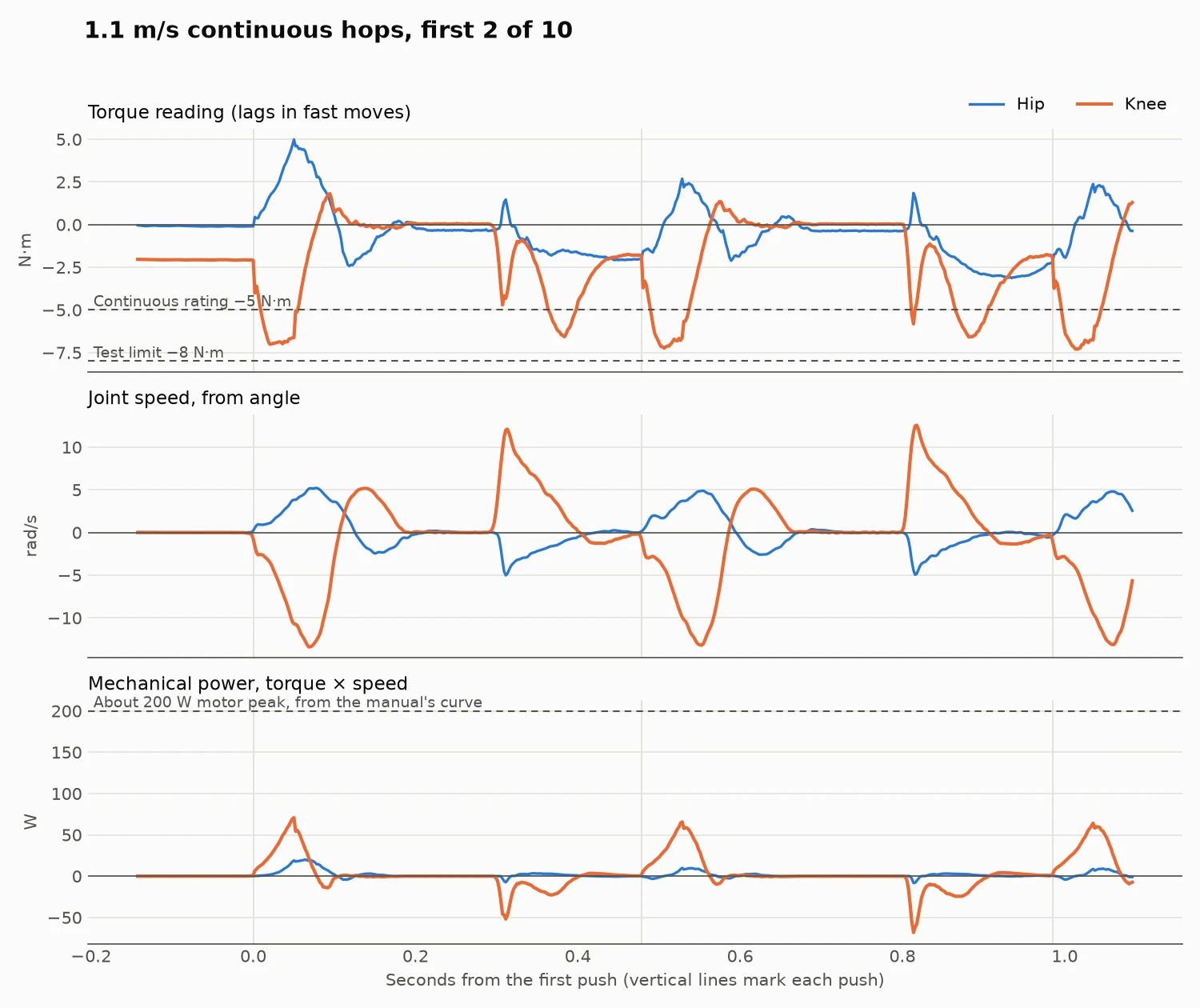
I didn't measure supply current during these runs, so the chart below is an estimate from the torque and speed, using the heat test's power readings for the losses. It suggests a peak of about 3.7 A at 1.1 m/s, close to the 4 A limit, for only about 50 ms.
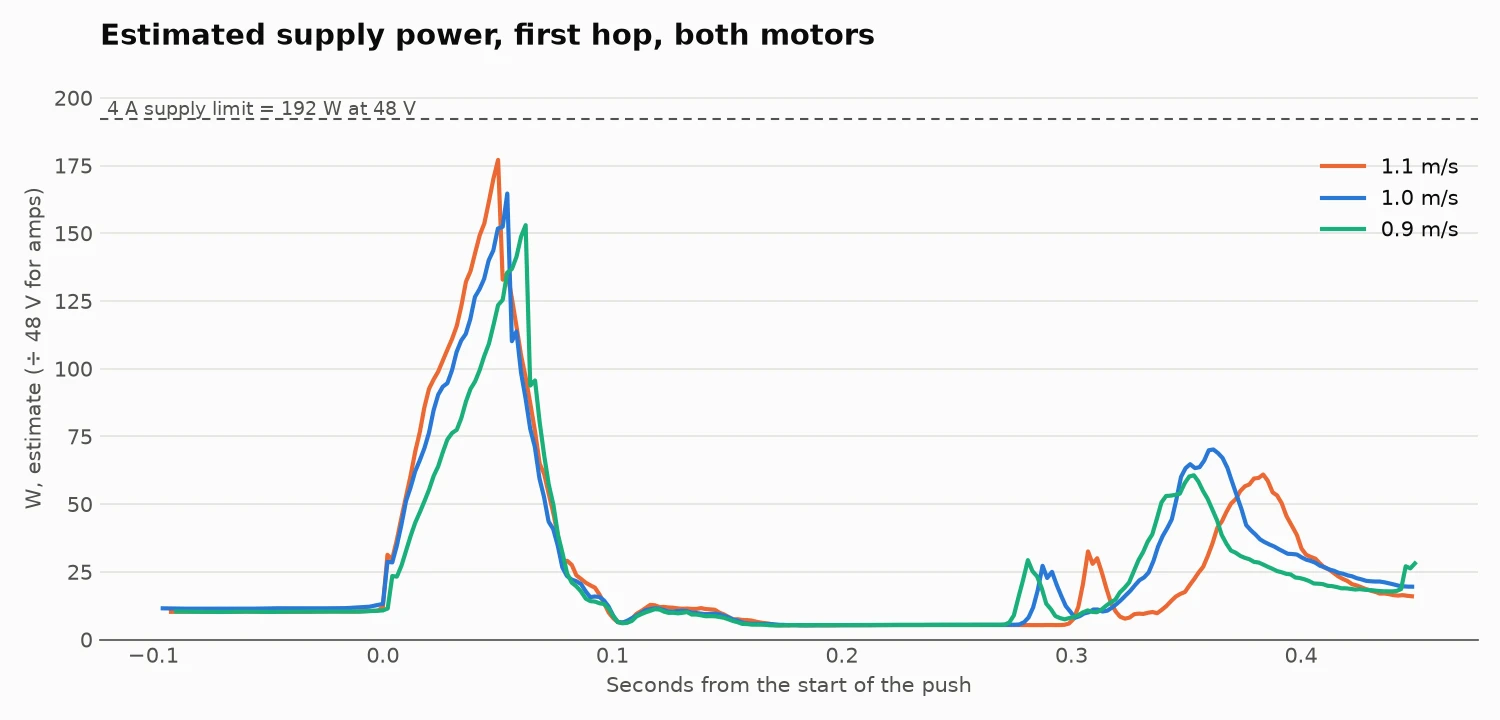
The RS00's manual publishes a torque-speed curve at 48 V. A spinning motor generates a voltage that fights the supply, so torque falls as speed rises. The curve shows 14 N·m at 100 rpm, about 9.5 N·m at 200 rpm and almost nothing at its 315 rpm top speed. Reading that chart, torque times speed peaks at about 200 W.
At 1.1 m/s, the knee's top speed was about 13.4 rad/s, or 128 rpm, where the curve allows about 13 N·m. The knee read 7.4 N·m. Its peak of about 71 W is roughly 35% of that 200 W, so the motors have room left. For this short push, my rough guess is that the motor alone could reach about 1.4 to 1.5 m/s. My 8 N·m test limit, the supply, the knee's distance from straight or the printed parts will probably stop it first.
Still open
- My hands are part of these numbers. The leg still has to show this with no one holding it.
- The beam rig needs a real pivot before it's useful for hops.
- Motors that switch off under load drop the leg, and this nearly caught me out again after one hop. I've written a gradual shutdown that fades torque under damping, but I haven't verified it yet. The real robot will need to sit down first, then ease off.
The printed leg looked fine when I checked it after the 1.0 m/s run.