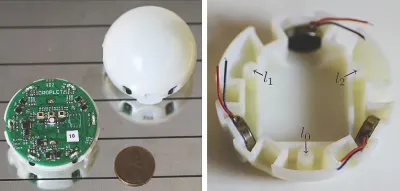
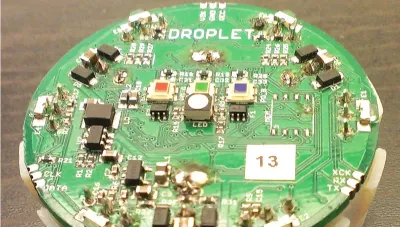
Overview
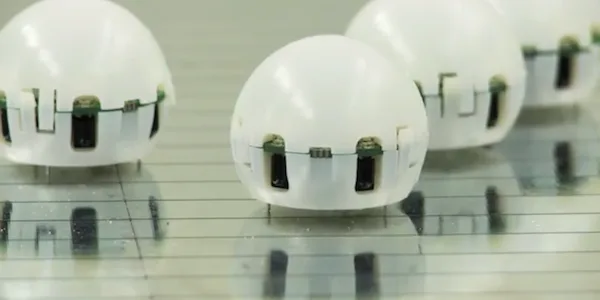
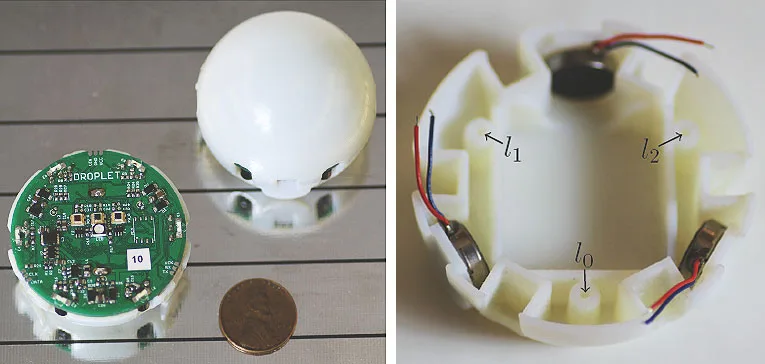
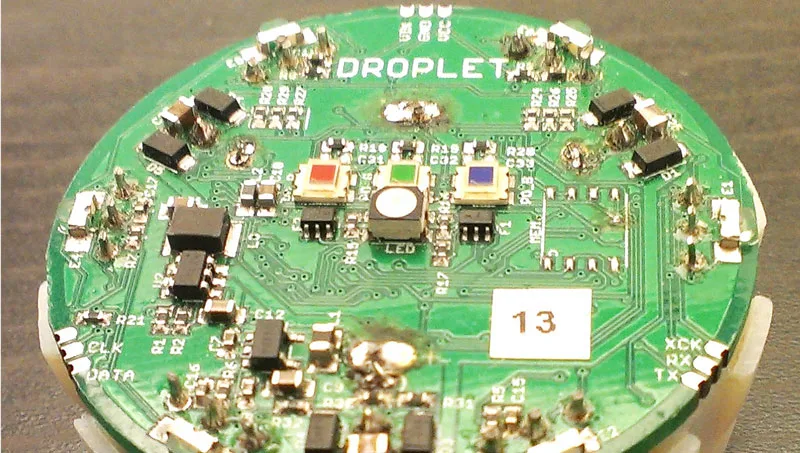
A ping-pong-ball-sized swarm robot built at Nikolaus Correll's lab at CU Boulder, meant to sit between the Kilobot and e-puck in size, cost and ability. Each Droplet uses six infrared emitters and receivers both to send messages and to work out the range, bearing and heading of neighbors from a 6×6 grid of signal strengths, so one broadcasting robot gives position information to every robot that hears it. Groups share the infrared channel with time slots, keeping in step with a firefly-style synchronization rule, and have been used to form shapes, camouflage themselves against a projected pattern and act as atoms in a chemistry simulation. The robots never need charging because their legs draw power from a striped electrified floor, and they can be poured out of a bucket and right themselves. The catch is that the whole system depends on that special floor, the robots were never sold, and the code and tools have not been updated since 2018.
- Type
- Wheeled robot · Research mobile manipulators & platforms
- Maker
- Correll Robotics Lab, University of Colorado Boulder (USA)
- Released
- 2013
- Price
- Not for sale
- Status
- Not for sale (research)
- Best for
- Professionals & labs
- Programming
- Open source (hardware + software)
Price and shipping
Never sold. A 2014 university crowdfunding campaign asked for at least $10,000 to build about 100 robots (about $100 each, half of it for shell molds) and said the cost would drop to about $30 per robot at 1,000 units (Robohub, May 2014). No shop or kit was found (October 2026 check). Year 2013 is when the cu-droplet GitHub repository was created; the main papers appeared at ICRA and IROS 2014.
Shipping: Not for sale. Not sold. Board files, shell models, floor design and firmware are on GitHub under a non-commercial Creative Commons license, so a lab can build its own robots and powered floor.
Specifications
| Category | Wheeled rovers · Research mobile manipulators & platforms |
|---|---|
| Released | 2013 |
| Country | USA |
| Availability | Not for sale (research) |
| Programmability | Open source (hardware + software) |
| Built-in autonomy | None / scripted · Moves only when controlled, or plays preset motions |
| LLM support | None · No LLM features. Programs are embedded C running on an 8-bit Atmel microcontroller. |
| MuJoCo simulation | None found · Nothing found. |
| NVIDIA Isaac simulation | None found · Nothing found. |
| Gazebo simulation | None found · Nothing found. The lab's own cu-droplet-sim simulator (C++, Qt) exists but is Windows-only and has not been updated since 2015. |
| Best for | Professionals & labs |
| Vision sensors | No vision sensors |
| Actuators | Other |
| Audio | No audio |
| Compute type | Arduino / ESP32 / microcontroller |
| Remote control | Via SSH / web / bridge |
| Size | About 44 mm diameter (2.2 cm radius) and 2.4 cm tall, nearly spherical with a flat bottom |
| Drive | Three vibration motors placed opposite three legs, giving omnidirectional stick-slip motion after a one-time camera calibration |
| Compute | Atmel ATxmega128A3U microcontroller |
| Vision | None |
| Lidar | None |
| Sensors | Six infrared emitters, six receivers with 38 kHz demodulation and six raw-amplitude infrared sensors for messages and range, bearing and heading of neighbors (2 to 20 cm), RGB color and brightness sensor on top, RGB LED, 16-bit unique ID |
| Runtime | Unlimited while on the powered floor (power through the legs from alternating +5 V and ground strips); supercapacitors bridge short contact gaps |
| Speed | Not published |
| SDK | Embedded C with the Droplet API, built in Atmel Studio and flashed with a PDI programmer (JTAGICE3 / Atmel-ICE); optional FTDI serial cable for debugging; hardware, firmware and floor designs under CC BY-NC-SA |
Common questions
How much does Droplet cost?
Not for sale. Never sold. A 2014 university crowdfunding campaign asked for at least $10,000 to build about 100 robots (about $100 each, half of it for shell molds) and said the cost would drop to about $30 per robot at 1,000 units (Robohub, May 2014). No shop or kit was found (October 2026 check). Year 2013 is when the cu-droplet GitHub repository was created; the main papers appeared at ICRA and IROS 2014.
Can Droplet be bought today?
No. It was never sold to the public.
Who makes Droplet?
Droplet is made by Correll Robotics Lab, University of Colorado Boulder (USA). It came out in 2013.
Can Droplet be programmed?
Open source (hardware + software). Embedded C with the Droplet API, built in Atmel Studio and flashed with a PDI programmer (JTAGICE3 / Atmel-ICE); optional FTDI serial cable for debugging; hardware, firmware and floor designs under CC BY-NC-SA.
Does Droplet have AI chat or LLM support?
None. No LLM features. Programs are embedded C running on an 8-bit Atmel microcontroller.
Ratings & reviews
Ratings and reviews load on the live site.
Related guides
- ROS 2 Guide · the software framework many robots use
- Robot Vision and Depth Sensors · cameras, lidar and other distance sensors
- Raspberry Pi Guide · every Pi compared for robot use
Similar robots
 KilobotHarvard Self-Organizing Systems Research Group / K-Team (USA / Switzerland)$1,320 (10-pack)
 PogobotSorbonne Université ISIR / ESPCI Paris-PSL (France)Not for sale
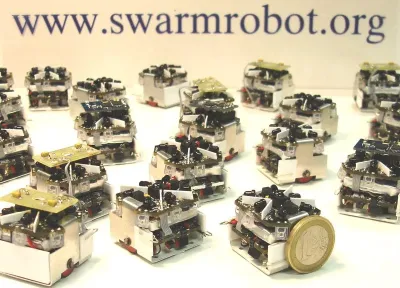 JasmineUniversity of Stuttgart / University of Karlsruhe, swarmrobot.org (Germany)Not for sale
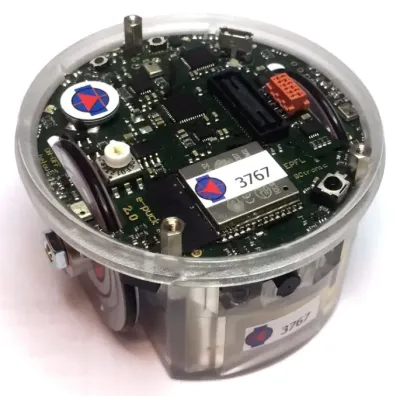 e-puck / e-puck2EPFL / GCtronic (Switzerland)$1,020
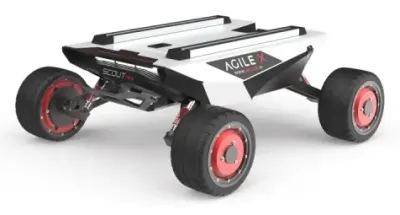 AgileX Scout MiniAgileX Robotics (China)$5,895.95 (Trossen)
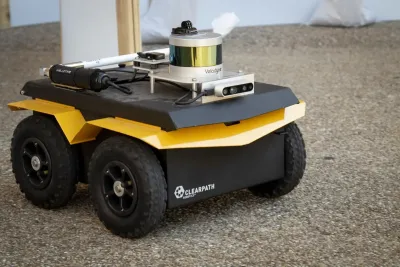 Clearpath JackalClearpath Robotics (Canada, part of Rockwell Automation)Quote (~$20,000+, est.)
Sources
Simulator (GitHub) ↗ · Robohub article by Correll (2014) ↗ · Crowdfunding coverage (2014) ↗ · Distributed camouflage paper (arXiv) ↗