Overview
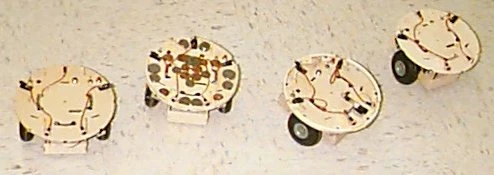
Four small robots built in 1999 for the Intelligent Machines Design Laboratory course at the University of Florida, made to show that very cheap hardware could let robots find each other, exchange messages and play children’s games together, about 12 years before the Kilobot. Each Dendrite has five infrared LEDs and five infrared receivers around its body, which serve as obstacle sensors, as a way to tell which direction another robot is in, and as the message link (range about 5 feet). A first protocol that gave every robot the others’ positions plus an 8-bit message needed about 2 seconds per cycle, so it was replaced by simpler pulse schemes built around each game. In Tag two robots trade infrared pulses about every 250 ms and the leader signals a tag with a long pulse, in Simon Says the leader encodes a move as a pulse length in 200 ms steps and the others re-broadcast it so the command spreads down a line like the game Telephone, and in Follow the Leader only the leader has a light sensor while the others follow its infrared beacon, which the report calls virtual sensor sharing. The report rates the project a moderate success, since the leader’s bump ring missed at least two-thirds of contacts and a chasing robot near a wall would sometimes follow reflected infrared instead of the other robot.
- Type
- Wheeled robot · Research mobile manipulators & platforms
- Maker
- University of Florida Machine Intelligence Laboratory (USA)
- Released
- 1999
- Price
- Not for sale
- Status
- Not for sale (research)
- Best for
- Professionals & labs
- Programming
- Full SDK
Price and shipping
Never sold. The final report lists about $295 in parts for all four robots, about $74 per robot (estimate), leaving out the wood, switches, visible LEDs, cables and board components supplied by the lab. Year 1999 is the Fall 1999 course, and the report is dated December 12, 1999.
Shipping: Not for sale. A one-off course project that was never sold. The final report, including the full C source code, survives as an archived copy on the Internet Archive.
Specifications
| Category | Wheeled rovers · Research mobile manipulators & platforms |
|---|---|
| Released | 1999 |
| Country | USA |
| Availability | Not for sale (research) |
| Programmability | Full SDK |
| Built-in autonomy | Reactive · Responds to its surroundings without a map, such as avoiding obstacles or following a person |
| LLM support | None · No LLM features. The robots ran small C programs on a 1990s 8-bit microcontroller. |
| MuJoCo simulation | None found · Nothing found. |
| NVIDIA Isaac simulation | None found · Nothing found. |
| Gazebo simulation | None found · Nothing found. |
| Best for | Professionals & labs |
| Vision sensors | No vision sensors |
| Actuators | Hobby servos |
| Audio | No audio |
| Compute type | Arduino / ESP32 / microcontroller |
| Remote control | Via SSH / web / bridge |
| Size | Small round Mekatronix TJ chassis of laser-cut balsa wood (dimensions not given in the report) |
| Drive | Two Hitec HS-422 servos modified for continuous rotation plus a plastic caster, differential drive that can pivot in place |
| Compute | Mekatronix MTJPRO11 board with a Motorola 68HC11 microcontroller and 32 KB of SRAM |
| Vision | None |
| Lidar | None |
| Sensors | Five infrared LEDs and five Sharp GP1U58X infrared receivers (modified for analog output) spread around each robot, used for obstacle avoidance, locating other robots and messaging. The leader also has a CdS light sensor and a wooden bump ring with six contact switches |
| Runtime | Not published (six AA NiCd cells per robot) |
| Speed | Not published |
| SDK | C for the 68HC11 using Mekatronix TJ libraries, with the full source printed in the final report |
Common questions
How much does Dendrites cost?
Not for sale. Never sold. The final report lists about $295 in parts for all four robots, about $74 per robot (estimate), leaving out the wood, switches, visible LEDs, cables and board components supplied by the lab. Year 1999 is the Fall 1999 course, and the report is dated December 12, 1999.
Can Dendrites be bought today?
No. It was never sold to the public.
Who makes Dendrites?
Dendrites is made by University of Florida Machine Intelligence Laboratory (USA). It came out in 1999.
Can Dendrites be programmed?
Full SDK. C for the 68HC11 using Mekatronix TJ libraries, with the full source printed in the final report.
Does Dendrites have AI chat or LLM support?
None. No LLM features. The robots ran small C programs on a 1990s 8-bit microcontroller.
Ratings & reviews
Ratings and reviews load on the live site.
Related guides
- ROS 2 Guide · the software framework many robots use
- Robot Vision and Depth Sensors · cameras, lidar and other distance sensors
- Raspberry Pi Guide · every Pi compared for robot use
Similar robots
 KilobotHarvard Self-Organizing Systems Research Group / K-Team (USA / Switzerland)$1,320 (10-pack)
 JasmineUniversity of Stuttgart / University of Karlsruhe, swarmrobot.org (Germany)Not for sale
 PogobotSorbonne Université ISIR / ESPCI Paris-PSL (France)Not for sale
 DropletCorrell Robotics Lab, University of Colorado Boulder (USA)Not for sale
 AgileX Scout MiniAgileX Robotics (China)$5,895.95 (Trossen)
 Clearpath JackalClearpath Robotics (Canada, part of Rockwell Automation)Quote (~$20,000+, est.)
Sources
Final report (archived PDF, 1999) ↗ · IMDL Fall 1999 projects (archived) ↗
Image credits
- Image 1: source (UF IMDL project photo, Fall 1999, archived by the Internet Archive)